How to Parallel Park: A Beginner’s Step-by-Step Guide

For most new drivers, parallel parking feels like one of the scariest maneuvers to master. Tight spaces, close cars, and that awkward turning moment can make even confident drivers nervous. But with the right technique and a little practice, it can become second nature.
At SafeWay Driving, we’ve taught thousands of students across Texas how to safely and confidently parallel park. Whether you’re learning through a driving school or at home with parent guidance, this guide walks you through the process, one step at a time.
Why Parallel Parking Matters
Parallel parking isn’t just about passing your Texas driving test; it’s a real-world skill you’ll use in city streets, busy school zones, and urban areas where parking is limited.
The Texas DPS or DPS-Authorized Road Test may test your ability to park properly within 18 inches of the curb, without hitting the curb or needing multiple adjustments. Not only that, mastering this maneuver shows control, patience, and situational awareness, which are all core skills for safe driving.
Step 1: Find a Safe and Legal Space
Practicing
Before you start on the streets, we recommend starting with practicing in a quiet parking lot or street with cones. We only ever use cones and poles for parallel parking (never vehicles or other “fixed” objects). During practice, we hope that cones and poles are not hit, but they are much more forgiving than a vehicle or structure.
Set up cones 26 feet apart (about two and a half parking space widths). The front cone is placed one vehicle width (approximately 7 feet) from the curb and represents the back left corner of the front vehicle - the one which we are parking behind. The back cone is placed half a vehicle (approximately 4 feet) width from the curb and represents the middle of the front bumper of the car we are parking in front of.
In Public
Before you begin parking in public, look for a space that’s at least 6 feet longer than your car. You need enough room to maneuver without scraping the bumper in front or behind you. Check for:
Fire hydrants or “No Parking” signs
Driveways or crosswalks
Oncoming traffic and parking
Always signal your intention to park and check your mirrors and blind spots before slowing down. This gives other drivers time to react and go around you.
Step 2: Line Up Properly
Pull up next to the front vehicle (or cone) so that your back bumper is even with the front cone.
Keep about one foot of space between your car and the parked vehicle (or cone).
Look out the window to find the pole (don’t rely on reference points).
This setup gives you the best angle to swing your car into the space without cutting it too sharply.

Step 3: Begin Reversing and Turning
This is the moment most beginners overthink. Stay calm, follow these steps, and use your mirrors.
Turn the steering wheel all the way to the right.
SMOG (Signal, Mirror, Over the shoulder, and Glance and Go) right
Slowly roll back to a 45-degree angle with your foot covering the brake (no gas).
When the pole is visible in the center of the passenger window, you’re in the correct position.
This angle helps your car pivot into the parking space. Be patient and smooth with your movements.

Step 4: Adjust and Complete
Once the front of your car clears the rear of the car in front of you, it’s time to adjust.
Turn the steering wheel all the way to the left.
Continue slowly rolling back while covering the brake.
Adjust the wheel slightly as needed to avoid hitting the front cone.
Stop before hitting the back cone.
If you’re too far from the curb, don’t panic. Pull forward slightly, straighten the wheel, and ease back in.
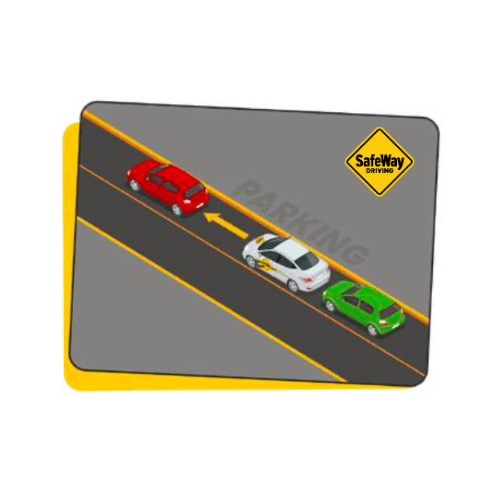
Step 5: Straighten and Center
You’re nearly done. Now it’s time to perfect your position.
Pull forward if needed to center and straighten the vehicle.
Ensure your car is 6 to 18 inches from the curb, with the left side not sticking out past the left cone.
Check both mirrors to ensure you’re not too close to the curb or the car (or cone) behind you.
If needed, make small corrections by pulling forward and backing up again. That’s perfectly normal, especially when you’re learning.
Common Mistakes to Avoid
Everyone messes up a few times during practice, but you’ll want to learn before you try the real deal. Here’s what to watch out for:
Oversteering too early, causing the front of your car to clip the curb
Understeering, which leaves you sticking too far out into the lane
Forgetting to check mirrors and blind spots when maneuvering
Getting flustered when another driver is waiting. Focus on your technique, not their horn.
Remember: Parking isn’t a race. It’s a precision move, and the more calmly you approach it, the better it will go.
Practice Makes Perfect: Where and How to Improve
We recommend practicing parallel parking in a safe, quiet area like an empty parking lot. Use cones or tall sticks to simulate parked cars, which reduces stress and allows you to learn the rhythm without the pressure of real traffic and immovable obstacles.
At SafeWay Driving, we offer structured lessons that help you build these skills with real-time guidance. Our instructors use dual controlled vehicles, giving new drivers the confidence to practice without fear of making a costly mistake.
The Test Day Version
If you’re preparing for your Texas road test, here’s what examiners are looking for in your parallel parking:
You signal before parking
You don’t touch the curb or the cones
You stay within 18 inches of the curb
You complete the maneuver smoothly, with minimal adjustments
According to the DPS, students must demonstrate vehicle control, awareness, and positioning accuracy. While small corrections are okay, repeated repositioning or hitting objects may result in a deduction or failure.
Why Professional Training Can Help
Mastering parallel parking often benefits from professional instruction. That’s because instructors at SafeWay Driving:
Know how to coach positioning in real time
Use cone-based setups to mimic test environments
Provide step-by-step correction with calm support
Prepare you for exactly what the DPS (or DPS-Authorized Road Test) will assess
Plus, our students reduce their crash rate by half compared to the state average per the DPS. This is thanks to our system, which has structured practice and a safe environment to learn in.
Final Thoughts: Your Parking Power Starts Here
Parallel parking doesn’t have to be scary. With the right setup, step-by-step technique, and a little patience, it becomes just another part of your driving toolkit.
Whether you’re preparing for your Texas driving test or simply want to sharpen your skills, learning how to parallel park is the right way to set you up for success every time you hit the road.
Need help practicing? Contact SafeWay Driving to schedule a lesson with an instructor who can walk you through it: cone by cone and turn by turn.